ML engineering · 3 min read
20,953 Pokémon cards, one iPhone, no server: building an offline card scanner
- cards in the catalog
- 20,953
- to the first tile
- ~1 s
- for a full page
- ~5 s
- per scan, no server
- $0
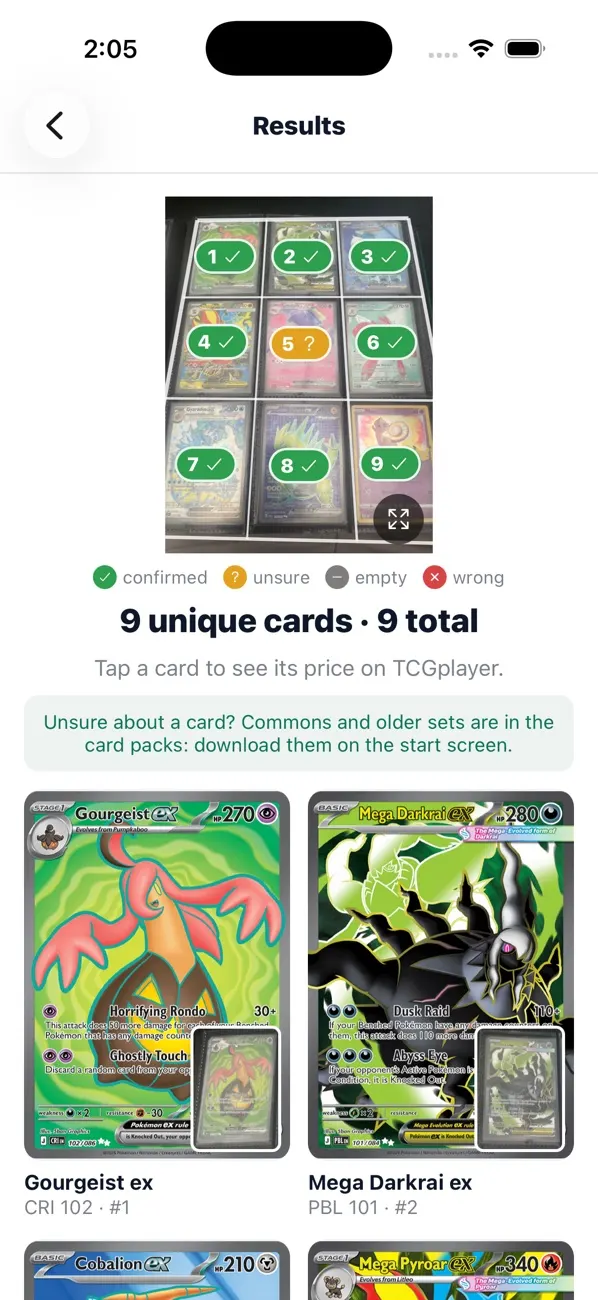
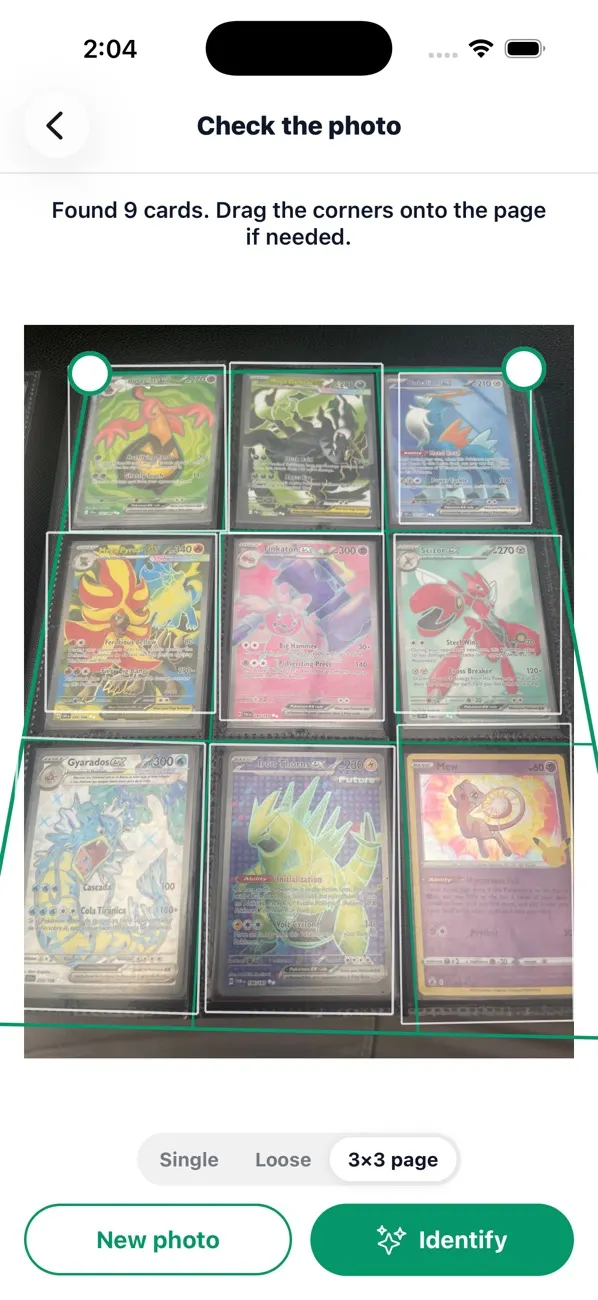
Photograph a binder page of Pokémon cards and every card is identified on the phone in about 5 seconds, with no server and no cost per scan. How it works, what moved the numbers, and the only model I trained.
 Ken Ruiz Inoue · October 2026
Photo in, answers out
Collectors keep their Pokémon cards in 9-pocket binder pages, and pricing a page means looking up every card by hand. Another Scanner does it from one photo: it finds every card, names the exact printing out of 20,953 English cards, and opens its price page. It all runs on the phone, so it works offline, costs nothing per scan, and photos never leave the device.
How a card gets identified
A small detector finds every card in the photo and straightens it. Then each card is narrowed down from the whole catalog to a single answer, going only as far as it needs; glare, sleeves and foil take extra steps.
Shortlist by look
Every card in the catalog, ranked by a pretrained model
Check the keypoints
The closest look-alikes, checked against the flat card
Answer
A verified match, for most cards in about a second
Weak match or a twin printing? The printed number on the card decides.
Only 1 of 4 pieces was trained
I trained a model only where nothing off the shelf fit a phone. The rest is a pretrained model used as is, classic computer vision, and the text recognition built into iOS.
- Trained by me
Find the cards
CardNet
40 minutes of training on 131 photos, 12.8 MB.
- Pretrained, used as is
Shortlist by look
DINOv2-small
Never fine-tuned; shrunk from 88 MB to 24 MB.
- Classic computer vision
Check the geometry
ORB + RANSAC
No training: an exact yes or no for a flat card.
- Built into iOS
Read the text
Apple Vision
Free and on device, used only for hard cards.
What moved the numbers
Three changes, each measured on the same real cards before and after.
The geometry check
Right by name, same 75 real cards
The vote fix
Right card in top 25, of 205 crops
A faster fitter
Seconds per page, lower is better
Where it stands
A tester scanned 16 binder pages with the app; the result is below. On holdout pages the system was never tuned on, it scores 73 of 86, and the misses come from glare and sparse pages.
135 of 139 right
- 135 right
- 3 unsure
- 1 wrong
The point
Most of the accuracy came from engineering, not training: a pretrained model to shortlist, geometry to decide, the printed text for what the picture cannot settle, and a number for every change. Start cheap, measure on real inputs, and train only where nothing else works. Pokémon is the test case; the same pipeline should carry over to any large catalog of look-alike printed items, such as other card games.
Pokémon and Pokémon card names and images are trademarks and copyrights of Nintendo, Creatures Inc., GAME FREAK inc. and The Pokémon Company. Another Scanner is an independent open-source project and is not affiliated with, sponsored or endorsed by them or by TCGplayer.