AI automation · 12 min read
How AI agents make our Instagram reels
We automated our Instagram reels with Claude Code and a small team of AI agents. After 10 days of reels, we hit 1,000 followers. This is the whole system, so you can copy it.
 Ken Ruiz Inoue · November 2026
This is the whole system behind @another_systems, from the idea to a reel ready to post, written so you can copy it. Every rule here comes from a real reel, and most of them from a reel we had to redo.
It's built for informative videos like ours, topics, facts and guides told with 2D cards, 3D scenes, an AI voice and captions. It isn't made for animated cartoons or comedy sketches. The guide gives you the method, the rules and every brief, but not our video code. Your agent writes its own from your reference video, so the first reel takes the longest.
The PDF ends with the briefs and a starting playbook as files, so your agent can use them as they are.
What you need
Claude Code, Anthropic's AI coding tool. Claude's $20 a month Pro plan is enough to make about 10 to 20 reels a month with no problems. Then Node.js, a small React app with three.js that draws each reel as a web page, headless Chrome to record it, and FFmpeg to turn the frames into a video.
The voice and the word check run on the laptop. We use Alibaba's Qwen3-TTS for the voice and NVIDIA's Parakeet to hear it back, both through mlx-audio on a MacBook Pro with an M1 Pro chip. The voice step also times every word with Qwen3-ForcedAligner, and those times light each caption word and cue every piece of the scene. On Windows or Linux, any local text to speech, speech to text and word timing models can do the same jobs. The music is made by code too, so there is no track to license.
A reference video. Play a reel in the style you want and record your screen, on your phone or your computer, then give the recording to your agent. Until you have approved reels of your own, it is the picture of done for every build.
And an Instagram professional account, which shows each reel's insights.
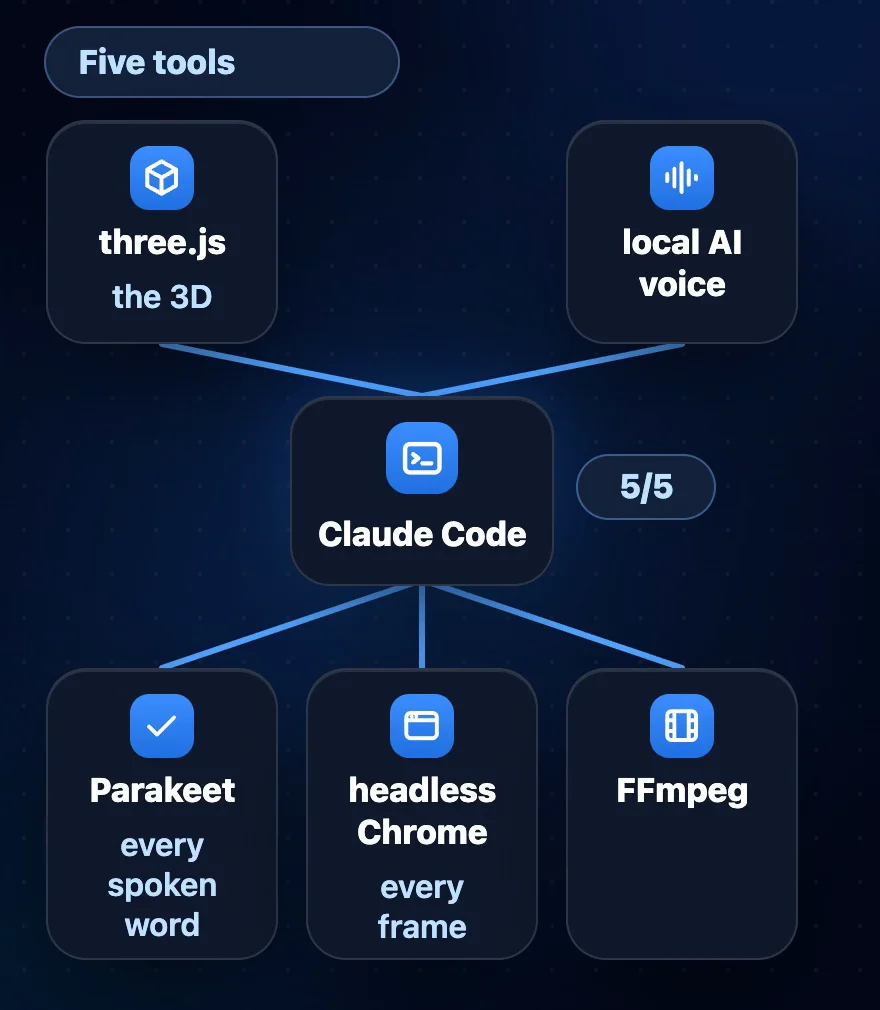
| Tool | Its job |
|---|---|
| Claude Code | Runs every agent. The only paid part |
| three.js | Draws the 3D scenes in a web page |
| Qwen3-TTS | The AI voice and its word times, on the laptop |
| Parakeet | Hears every line back to catch a cut word |
| Headless Chrome | Records the page, frame by frame |
| FFmpeg | Joins frames, voice and music into the video |
The folder
Everything lives in one folder that the agents read and write. The names are ours, and yours can be anything.
Each reel's script folder keeps its research, a sources file with the page behind every number, the reviews and a decision log. When a choice is made, the log says why, so a later agent never undoes it by accident.
| In the folder | What it holds |
|---|---|
| playbook.md | Every rule, each with its date and the note that made it |
| builder_brief.md | What a builder agent gets for one reel |
| reviewer_briefs.md | The four review roles, one brief each |
| queue.txt | Reel ideas as tickets, their owner and stage |
| catalog.md | Every reel made, its lines, sound and numbers |
| posts/ | One folder per reel, the video, cover, caption and script |
| src/ | The code, one page per reel with its timeline and voice lines |
The playbook
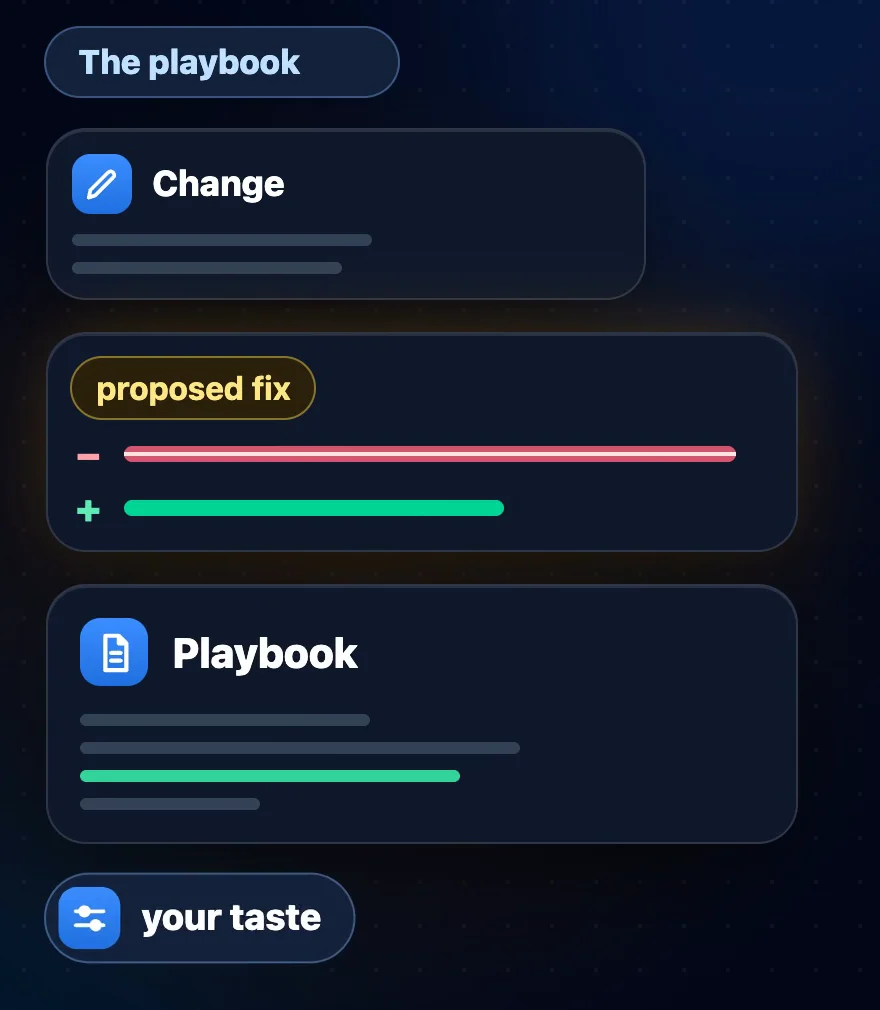
The playbook is the heart of the system. It is the list of rules every agent reads before it starts, and it grows with every review. Ours now covers the hook, the length, the captions, the 3D look, the sound and the caption under the reel.
Start yours with rules like these, then let your notes change them. Every rule carries the date and the note that made it. Where two rules disagree, the newer one wins.
| A rule to start with | Why |
|---|---|
| Something famous in your niche in the first words | About half our viewers were gone by 3 seconds |
| The first frame is a full picture, its words already lit | An empty opening gives them no reason to stay |
| Up to 10 spoken lines, about 60 seconds | Our reels kept running long |
| Every word said is on screen, nothing before its word | Eyes and ears tell one story |
| Every number from a primary source | One wrong fact costs trust |
| Each line explains its own terms | A non-engineer should follow every line |
| 3D for real objects, glass cards for anything read | Text stays sharp, objects feel real |
| Every gap 16 px, every card padded 20 px | Uneven gaps look cheap |
| Dim by color, never by transparency | Faded pieces look broken |
| A fresh music mix for each reel, picked by its mood | Repeats make every reel sound the same |
The queue and the agents
Ideas wait in the queue as tickets. A ticket names the topic, the hook, the maker's own page that proves the story, and who owns it. A topic without that page never becomes a ticket. One of ours turned out to be a reseller's listing, not a real release.
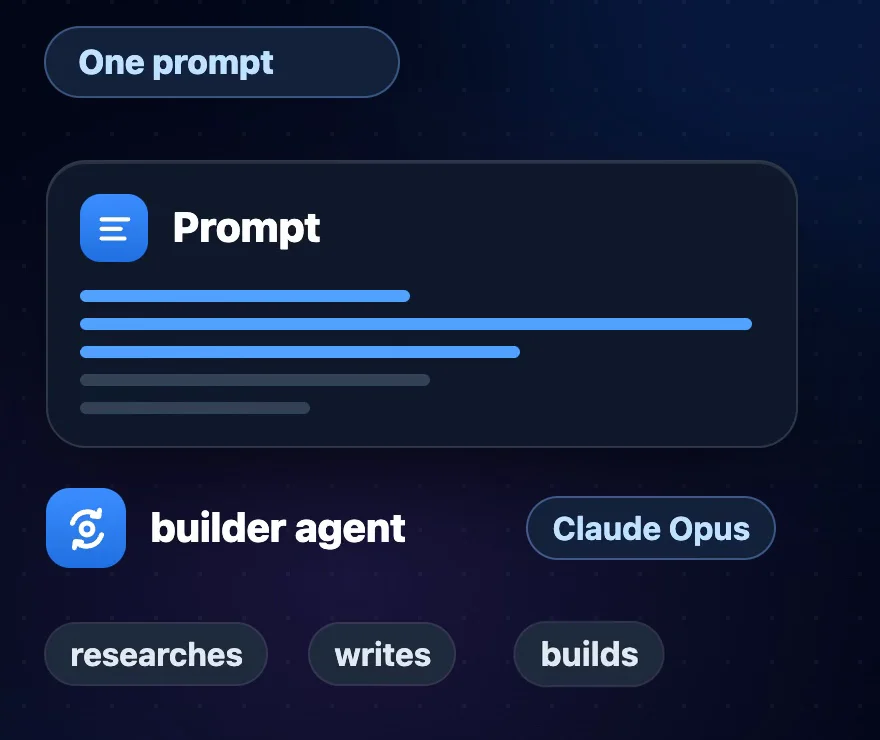
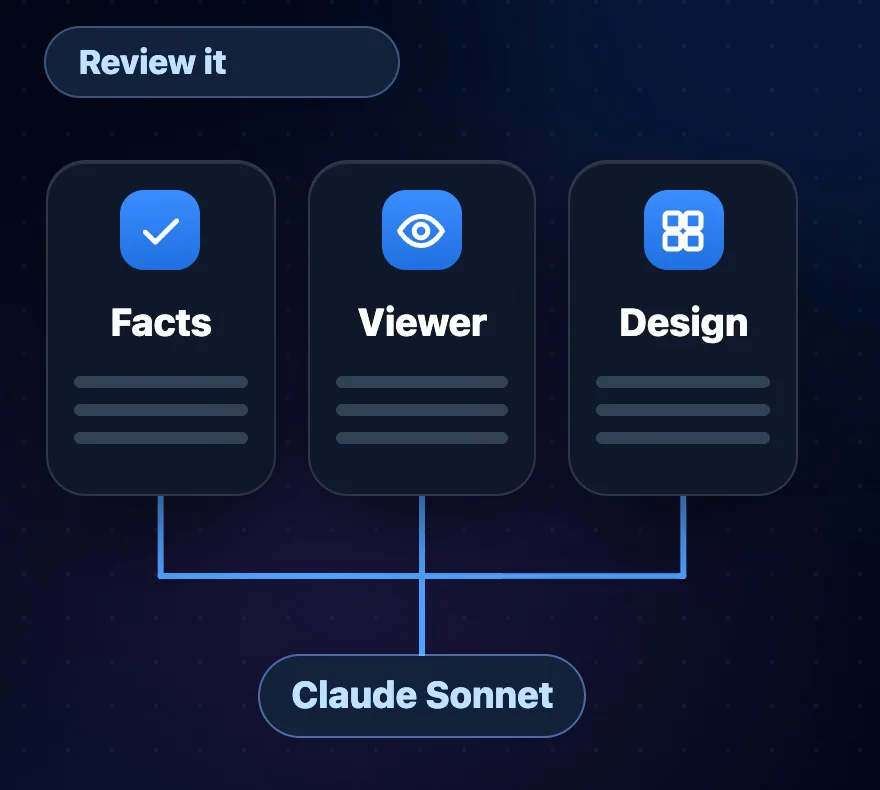
The main Claude Code session is the coordinator. It claims a ticket and starts one builder agent on Claude Opus with the builder brief. At the script stage it starts the three Claude Sonnet reviewers at the same time, and after the first render, the frame auditor. That is 5 agents per reel, and never more than 3 running at once. More only burns tokens.
One builder per reel. It writes a checkpoint into the script at every stage, so if it stalls, a new builder picks up from the checkpoint instead of starting over.
The builder
The builder gets the topic, the reel's name and its brief, and works in three stages. It stops and reports to the coordinator after each one. It copies the look of your reference video, or of your own approved reels once you have some.
The script. Research on primary sources, saved with the sources file. Then the lines, a plan for every line of what the screen shows, 3D or glass for each piece, and the decision log. Nothing is voiced yet.
The build. It reads the three reviews, decides each point and logs why. It voices every line and hears each one back, builds the scenes, checks the key frames, makes the music, the mix, the cover and the video, and hears the finished video once more. It writes the Instagram caption too, so the reel is ready to post. Then it pulls about 24 frames at the key moments for the auditor.
The finish. It fixes every blocking item from the audit, renders again and runs the audit loop. When a round comes back clean, it writes the reel into the catalog.
The brief also carries the house rules, the short version of the playbook. Ours include no em dashes, no colons in the caption, the newest examples from the makers' own pages, never saying why a reel was made, and never posting anything on its own.
The three reviewers
The reviews happen on the script, before a single frame exists. A fix there costs one line. The same fix after the build costs a render.
The fact checker checks every claim and every planned label against primary sources, on the web itself. It looks for missing qualifiers like "about" or "up to", something true of one model said of another, and examples older than they need to be. Each problem comes with the source's quote and the exact new words.
The new viewer reads as a non-engineer scrolling past, deciding in 2 seconds. Does each line name its own subject? Does "it" point at the right thing? Is the hook famous enough? It counts the lines and words, names what to cut, and drafts the caption.
The visual designer checks the plan against the code. Every 3D object stays whole on screen, glass for everything read, nothing shown before its word, room around every card. It writes a build spec for each line.
One real catch. A draft line said a 2018 study of over 17,000 Android apps found none sending out audio in its tests. The fact checker read the paper and found that only about 9,100 of them ran in the tests. The line became "A 2018 study tested about 9,000 Android apps and found none sending out audio" before the voice was made.
The script check, if you want it
By default the build starts right after the reviews. If you want a say earlier, tell the coordinator to stop there, once for one reel or as a rule in the playbook for every reel.
It then shows you the reviewed script, the lines and the plan for each scene. Approve it, or change lines in your own words, and the builder starts only on your yes. A changed line costs nothing here, while the same change after the build costs a new voice and a new render.
The audit loop
After the first render, one auditor gets about 24 frames, the cover, the lines and the caption, and does two jobs. As a viewer, it looks for anything clipped, crowded, too small for a phone, or shown but never said. As a fact checker, it checks every number again, everywhere it appears.
Each problem is marked blocking or minor, with an exact fix. The builder fixes them, then audits the whole reel again, until a round finds nothing, at most 5 rounds. If round 5 still finds something, the reel waits for a person.
The auditor misses taste. It passed tangled tubes we called spaghetti and a plain gate we called lame. So it now compares every 3D object with a sheet of objects we already approved, and anything that looks like stacked shapes fails. Scenes that cut away too soon fail too. Each scene now stays at least 1 second after its last line ends.
Your review
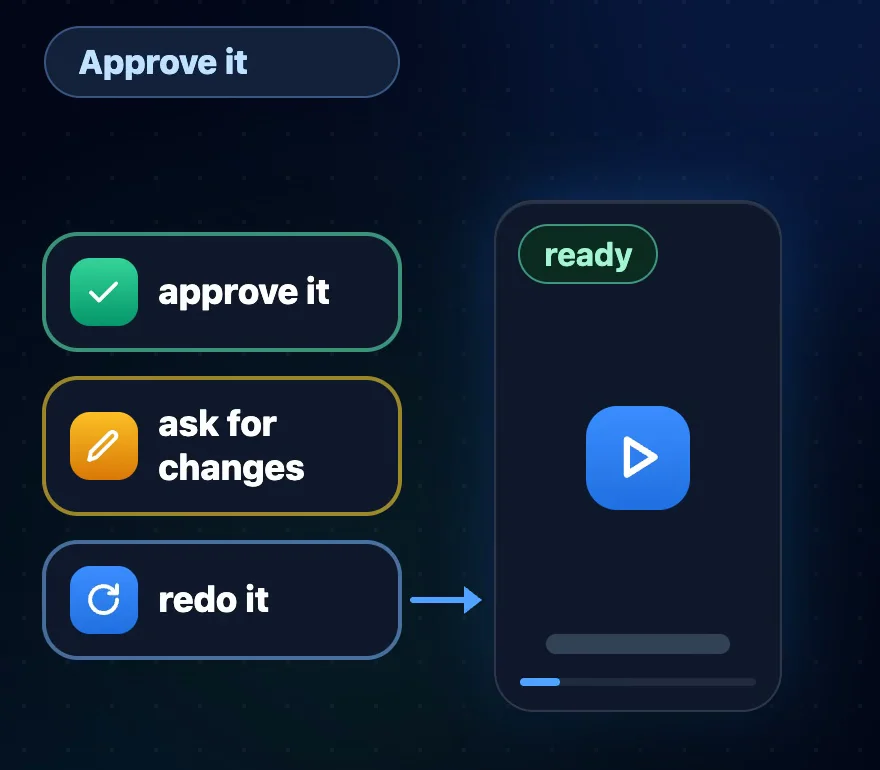
You watch every finished reel before it goes out. Approve it and post it yourself, or write what to change in your own words.
Each note does two things. The agents fix the reel, and they write the rule your note implies into the playbook, with the date and your words, and tell you what changed. You keep the rule or undo it.
A note that one scene cut away too fast became the 1 second rule. A note that faded cards looked wrong became dim by color. Neither has come up again.
Your numbers
For now this step is by hand. Every few days, open the insights of the newest reels in the Instagram app and give the agent the numbers, typed or as screenshots. Each reel's chart of how long people watched gives the share still watching at 1, 3, 5, 10, 30 and 60 seconds. The agent logs them in the catalog, next to the reel's topic, opening and length.
Look for patterns, not single reels. Ours showed most viewers leaving in the first 3 to 5 seconds, and the curve going nearly flat after about 10. The two best openings put a famous name on screen first. Everyday topics held about twice as long as AI news.
The same table shows which reels won people over on their own. Those are the only ones we put ads on.
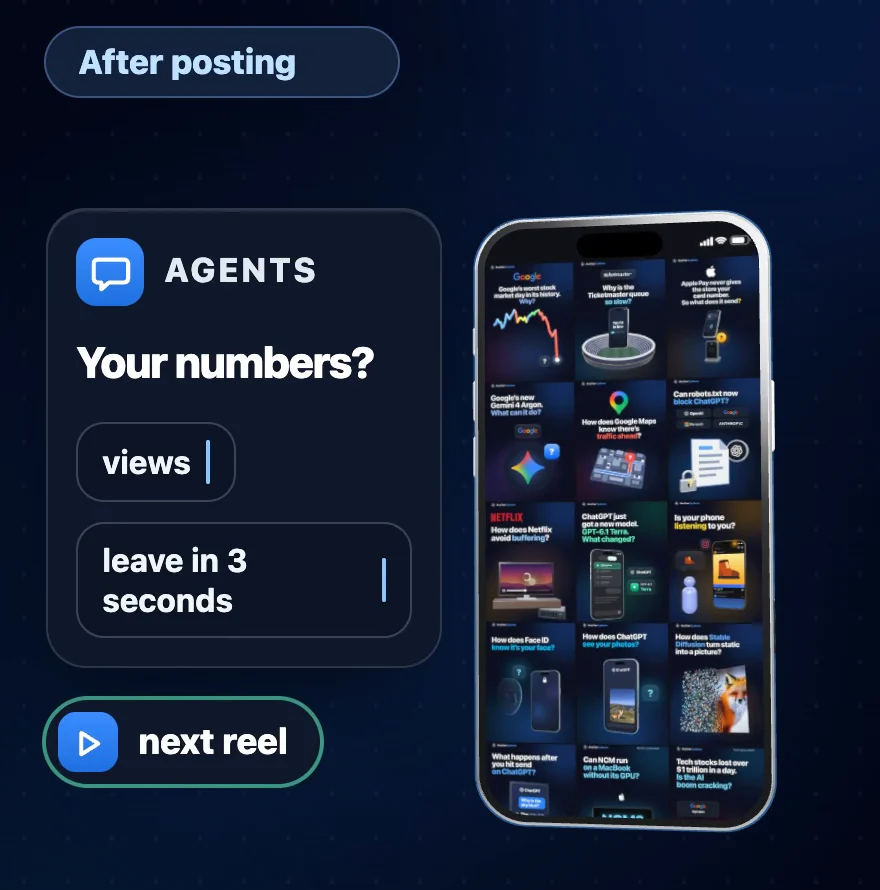
The numbers pick the next reel, not a guess.
- 1You post the reel
- 2Read its insights
- 3Give the agent the numbers
- 4It logs them
- 5Next topics
| Our reel | Watching at 3 s | At 10 s | At 30 s |
|---|---|---|---|
| How Google Maps sees traffic | 52% | 28% | 23% |
| How Apple Pay works | 50% | 32% | 21% |
| The Ticketmaster queue | 36% | 26% | 22% |
| ChatGPT, after you hit send | 47% | 29% | 18% |
| Gemini 4 Argon news | 38% | 20% | 15% |
| GPT-6.1 Terra news | 33% | 16% | 11% |
What cost us reworks
Every rule in the playbook started as a mistake. These were the expensive ones.
| What went wrong | The rule now |
|---|---|
| Reels ran 62 to 70 seconds | Up to 10 lines and 60 seconds |
| Tangled tubes and a plain gate passed the audit | Each 3D object is compared with approved ones |
| Builders stalled halfway | A checkpoint at every stage |
| A reseller listing almost became a reel | A maker's own page before any ticket |
| Uneven gaps between cards | One spacing system, 16 and 20 px |
| Scenes cut away too fast | Each scene stays 1 second after its last line |
Start your first reel
Make an empty folder and put this guide's PDF in it, with a screen recording of a video in the style you want. Open Claude Code there, or any AI agent that can read files and run commands, and paste this prompt. The agent takes it from there.
"Read the guide PDF in this folder. Set up its system in this folder. Write playbook.md from its starting playbook, builder_brief.md and reviewer_briefs.md from its briefs, and an empty queue.txt and catalog.md. Use the screen recording in this folder as the reference for the look. Then ask me for my account's niche, my style rules and my first reel idea, and run that reel up to the script stage. Stop there for my review."
More on this system is coming soon, so stay tuned.
The point
Copy the folder, not our taste. The playbook, the briefs and the numbers table are the system. Your notes become its rules and your numbers pick its topics, so after a few weeks the reels are yours.
Claude and Claude Code are trademarks of Anthropic, and Instagram of Meta. The reels named here are our own. This guide is independent, not affiliated with or endorsed by Anthropic, Meta, Alibaba, NVIDIA or any other company named. Follower and viewer numbers are our account's own, from Instagram's insights, and yours will differ.